
Key Takeaways:
- Rapid reproductive cycles allow fly populations to explode within days, making immediate action more effective than manual swatting.
- Accumulations of dark specks (feces and vomit) on high surfaces or near drains are key indicators of an established infestation.
- The presence of maggots confirms that flies have found a moist, organic breeding source inside the home.
- Large groups of stationary or sluggish flies on ceilings and windows suggest the pests are overwintering in the walls rather than just passing through.
- Successful elimination depends on identifying the specific species to locate and remove their unique breeding source, such as clogged drains or decaying organic matter.
It only takes one fly in your house to drive you crazy. When there are dozens, you’ll need to use more than a flyswatter to get rid of them – you need a professional fly exterminator.
Fly infestations are stubborn because flies reproduce rapidly. Female houseflies can lay up to 100 eggs at a time, and they can hatch within 24 hours. Over the course of days and weeks and months, that adds up to a lot of flies, which underscores the need to catch them early.
In this article, we’re going to talk about the signs of a fly infestation, help you understand the difference between just a few flies and a full-blown infestation, and teach you to identify what fly species you’re dealing with. Ready to get started?
3 Signs of Fly Infestations
1. Dark Clusters – Fly “Droppings”
Because they’re almost impossible to separate just by looking at, when we talk about dark clusters of fly droppings, we’re actually talking about two things: fly poop and fly vomit. Flies leave behind feces and/or vomit pretty much wherever they land.
Over time, these substances pile up and look like clusters of tan to brown to black dots. You can find these clusters on windowsills, near sink drains and around trash bins. Look for clusters in out-of-the-way places such as on top of the refrigerator or on high shelves. If you see them in large quantities, there’s a good chance you have a fly infestation.
- What does fly poop look like? They are tiny, circular specks about the size of a pinhead, usually black in color. If it’s fresh, it might have a slight glossy or wet sheen; if it’s old, it looks like a matte, dried ink stain. Flies are creatures of habit, so you won’t just find one dot; you’ll findclusters of dozens of these dots in specific areas.
- What does fly vomit look like? These spots are usually lighter in color (tan or amber) and slightly more transparent than the poop.
2. Finding Maggots in Waste
If you spot maggots in your home, it’s a sure sign of a fly infestation. Female flies look for moist, dark areas in which to lay their eggs. They’ll lay them in trash, rotting food and manure.
When flies invade your home, they may lay eggs in leftover food on the counter or on feces in the litter box. Maggots will soon emerge from the eggs and feed on the trash or feces.
3. Seeing Flies in Your Home
This is an obvious one, but it bears mentioning so you can understand the difference between a few flies – and an actual fly infestation.
Look for high concentrations of flies resting on ceilings, light cords, or high wall corners after dark. If you see dozens of flies stationary in the same high spot every night, they aren’t just passing through — they have claimed your home as a long-term habitat.
Also, look for “slow” or “lazy” flies. Not all infestations are the fast, buzzing houseflies we hate. Finding large, dark, slow-moving flies congregating on the sunny side of windows or in attics is a sign that they have established themselves and don’t plan on leaving. .
These flies aren’t looking for your food; they are “overwintering.” They’ve crawled into your walls to hibernate and are now leaking into your living space.
At Valley Pest Solutions, we’re always ready to help you with your pest control needs. Contact us for a free, no obligation quote, or call us at 209-481-1338 to get started today.

Leave your information below and we’ll be in touch with a FREE quote!
*During normal business hours. After hours calls will be returned the next business day.
How Do You Know What Type of Fly Infestation You Have?
Flies love the climate here in the San Joaquin Valley, and as a result, unfortunately, we deal with a wide variety of types. To help you determine which you’re dealing with, we’ve broken them down by what they look like and where you are most likely to find them.
Diagnostic Chart – How to Identify Different Fly Species
|
What they look like… |
Where you found them… |
Likely dealing with… |
The Breeding Source |
|
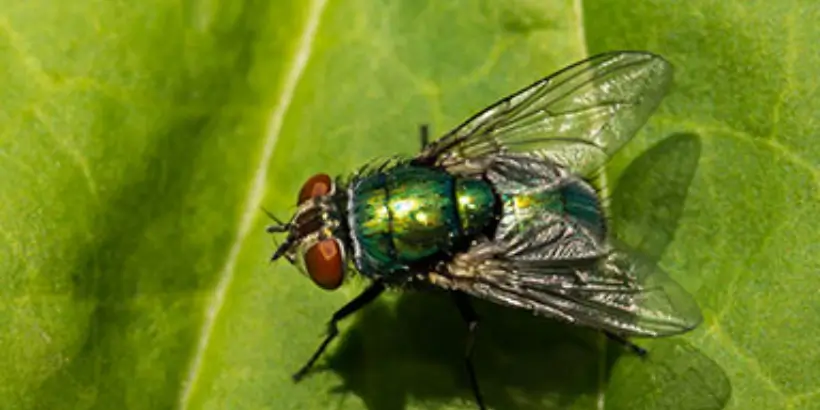
Large, metallic green, blue, or bronze bodies; loud buzzing. |
Windows & Skylights |
Blow Flies |
A dead animal (rodent/bird) in a wall, chimney, or attic. |
|
Tiny, moth-like, “fuzzy” wings; they sit still on walls. |
Bathroom & Kitchen Walls |
Drain Flies |
Gelatinous “bio-sludge” inside drains and sewage pipes. |
|
Small; usually have bright red or dark eyes. |
Countertops & Fruit Bowls |
Fruit Flies |
Fermenting organic matter (overripe fruit, dregs in bottles). |
|
Tiny black gnats; they “hop” or crawl on soil. |
Indoor Potted Plants |
Fungus Gnats |
Overwatered potting soil or decaying roots. |
|
Large, dark gray, “clumsy” or sluggish movement. |
Attics & Sunny Wall Voids |
Cluster Flies |
Earthworms outdoors (they enter homes only to hibernate). |
|
Classic gray body with 4 dark stripes on the back. |
Food Prep & Trash Areas |
Houseflies |
Decaying food, garbage, or pet waste. |
|
Tiny; distinctive “humpbacked” shape; erratic flight. |
Floor Drains & Leaks |
Phorid Flies |
Decaying matter in cracked pipes or under floorboards. |
Professional Fly Control in the San Joaquin Valley
If flies have taken over your home, don’t reach for a flyswatter. Contact Valley Pest Solutions to set up an appointment with our certified residential pest control pros.
Whether it’s houseflies or gnats, the infestation will only get worse if you don’t take quick action or use the appropriate treatment methods. Our fly control technicians will correctly identify the flies and treat them with fast, effective solutions for preventive control.


